At the end of November, I’ll be travelling to Seoul for the first time.
This isn’t just another trip for me. My daughter, Leana, is graduating in Seoul, so the journey already has a very personal reason behind it. But it also gives me the chance to discover a city and a culture that are completely new to me.
And, as anyone who knows me will probably guess, I haven’t simply booked the flights and decided to see what happens when I arrive.
For me, planning is part of the pleasure of travelling.
I love researching neighbourhoods, finding beautiful places to stay, looking for restaurants I wouldn’t want to miss and discovering museums, crafts and experiences that help me understand a place beyond its obvious sights.
But I don’t want every hour accounted for either.
The aim is to arrive feeling prepared, while still leaving enough space to wander, change our minds and make discoveries along the way.
So, as I prepare for my first trip to Seoul, I’m sharing exactly how I’m organising it: from choosing where to stay and what to book in advance to money, transport, useful apps, food experiences and the practical things I’m sorting out before leaving.
Hopefully, it will help you plan your own Seoul adventure too.
Slow down. Savour more. Reconnect.
In this guide
Planning my first trip to Seoul
Choosing where to stay in Seoul
Building an itinerary without overplanning
What I’m booking before I leave
Discovering Seoul through food
Art, museums & traditional crafts
Money & paying in Seoul
The apps I’m preparing before Seoul
Getting around Seoul without spending the day in transit
The practical things I’m sorting out before leaving
Planning collaborations before I travel
What I’m deliberately not planning
This article contains affiliate links. If you click through and make a booking or purchase, we may earn a small commission at no extra cost to you. Your support helps us keep Travelling Cooks alive and sharing more recipes and travel tips.
Planning my first trip to Seoul
My first stay in Seoul will be from 25 November to 1 December, before we travel on to Japan. I’ll then return to Seoul for a few more days before flying home.
For the first part of the journey, I’ll be travelling with my son, Sebastian, and our close family friend Lidde, whom some readers may remember from my travels in Denmark. Leana will then join us after her graduation, making us four for the final days in Seoul and for our trip to Japan.
Rather than treating Seoul as one long stay, I’ve found myself planning the trip in different chapters.
The first few days will be about discovering the city for the first time, with a mixture of neighbourhoods, food, art and traditional Korean culture. Then comes the main reason for the trip: celebrating Leana’s graduation.

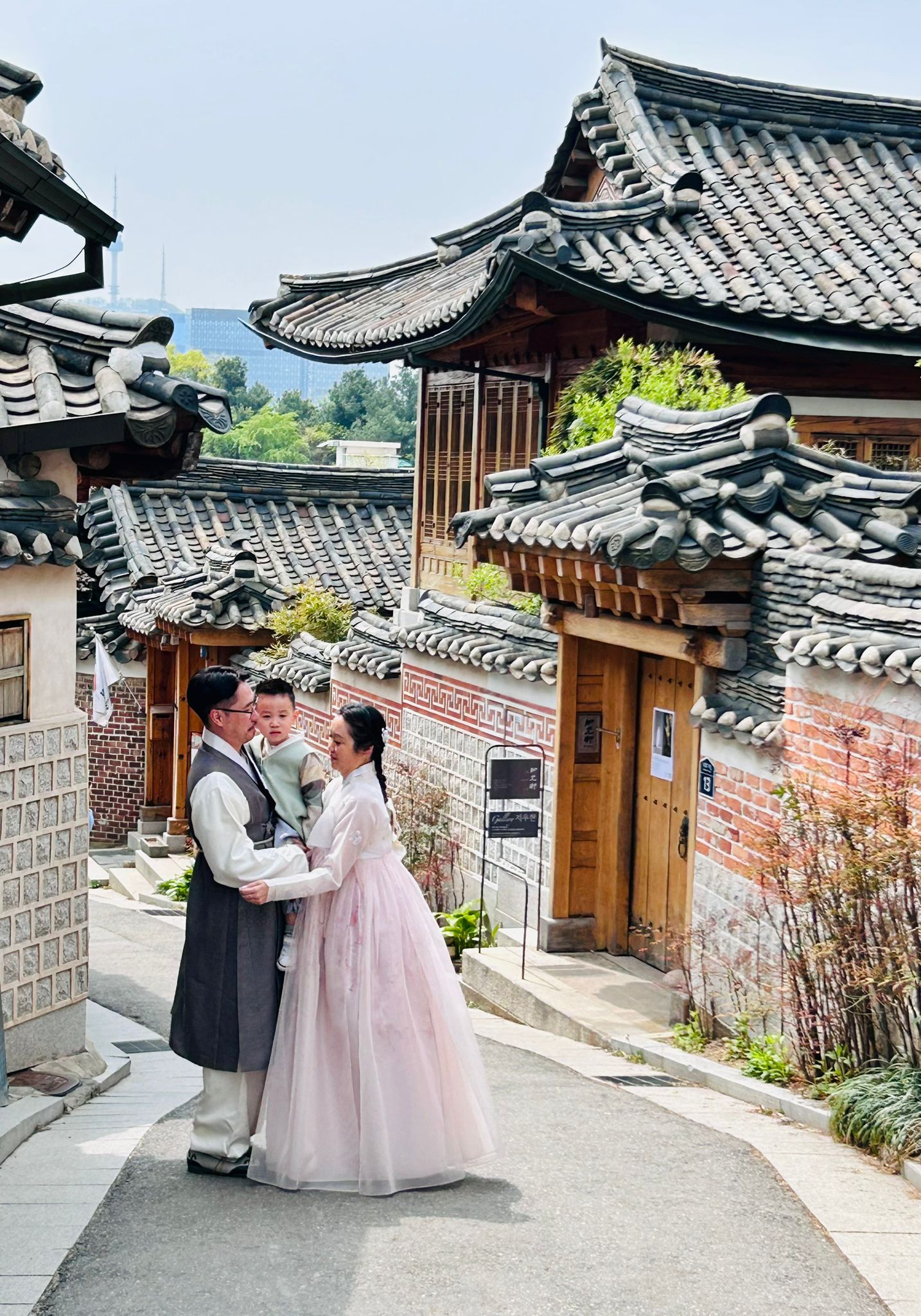
After that, we’ll slow things down a little. With Leana joining us, we’ll move to a traditional hanok stay in Bukchon, giving the four of us the chance to experience another side of Seoul together before leaving for Japan.
I’ll then return to Seoul after our few days in Hokkaido, with a little more time to explore before the journey home.
Having these different parts to the trip has actually helped me plan it. Instead of trying to fit every Seoul recommendation I’ve saved into a few days, I’m thinking about what makes sense for each part of the journey and, most importantly, who I’m travelling with.
There are already a few fixed moments around which everything else can fall into place: a food tour, a traditional Hanji craft experience, Leana’s graduation and a few museums and restaurants that are particularly high on my list.
The rest I’m deliberately leaving a little looser.
I want to arrive knowing that the important things are organised, but with enough space to wander into a café, stay longer somewhere we love or simply change our plans because Seoul leads us somewhere unexpected.
Choosing where to stay in Seoul
Choosing where to stay in a city I’ve never visited has probably been one of the more challenging parts of planning Seoul. It’s a huge city, and I quickly realised that looking for the most “central” hotel wasn’t necessarily the best approach.
Instead, I’ve tried to think about what we need from each part of the trip and choose our accommodation accordingly.
For our first four nights, Sebastian, Lidde and I will be staying at Hotel DAAM. I wanted somewhere that would give us a comfortable base for our first days in the city and work well with the places and experiences I was beginning to add to our itinerary.
When Leana joins us, we’ll move to Bukchon Binkwan by Rakkojae for our final two nights before Japan.


This was a very deliberate choice. Rather than simply changing hotels, I wanted this part of the trip to feel different. Staying in a traditional hanok in Bukchon will give the four of us an opportunity to experience another side of Seoul together, surrounded by an older, more traditional part of the city.
When I return from Japan, the trip changes again. I’ll have a few more days in Seoul before flying home, including some time on my own, so my priorities are slightly different: a convenient location, somewhere I feel comfortable returning to at the end of the day and good transport connections, particularly for the journey to the airport.
What I’ve learnt from planning my accommodation is that you don’t necessarily have to find one perfect area of Seoul. If your trip is long enough, changing neighbourhoods can become part of the experience and allow you to see the city from a different perspective.
I’ve also been reminded how valuable personal recommendations can be. Social media is wonderful for inspiration, but some of the most useful advice I’ve received has come directly from people who live in Seoul or have lived there.
Over the years, between my children and me, we’ve built friendships and connections in many different parts of the world. It means that when I’m planning a journey, I can often reach out to someone who actually knows the destination and ask the questions that don’t always have an obvious answer online.
That’s something I also bring to my travel planning. I don’t rely solely on what’s trending on TikTok or appearing in a “top ten” list. I research, I ask, I compare and, whenever possible, I go directly to people who know the place.
And because some of them know me too, they understand the kind of places and experiences I’m looking for.
Ask around before you book. Someone in your circle may know the destination far better than you realise. The best travel planning often comes from combining local knowledge with careful research and, of course, leaving a little room for your own discoveries.
Building an itinerary without overplanning
Once I had decided where we would be staying, I started building the itinerary around the things that couldn’t move.
For us, that means Leana’s graduation, an evening food tour with Korean Gourmet Hunters, and a traditional Hanji workshop at Bukchon Hanji Studio. Both experiences are collaborations I’ve arranged for Travelling Cooks, and I’m looking forward to discovering them for myself and sharing more with you afterwards.
These became the anchors of the trip.
From there, I began looking at what else was nearby rather than creating a list of everything I wanted to see and trying to squeeze it all in.
Seoul is a huge city, so I’ve been grouping museums, neighbourhoods, restaurants and experiences geographically wherever possible. If we’re spending part of the day in Bukchon, for example, it makes much more sense to explore what is around us than to cross the city because I’ve saved a restaurant on Instagram.
I also try to think about the rhythm of the day.
A museum followed by a long lunch and a walk through a neighbourhood might be enough. Another day may have more planned. And if we have an important evening ahead, I don’t necessarily want to fill every hour beforehand.
This is very much how I approach travel planning, whether I’m organising one of my own journeys or creating an itinerary for someone else. I start with the things that really matter, look at distances and logistics, and then build around them while leaving some breathing room.
Because a good itinerary, for me, isn’t one that proves how much you managed to see.
It’s one that gives you time to actually enjoy where you are.
Choose a few non-negotiables first, group the rest of your plans by area and resist the temptation to fill every empty space. Some of the best moments of a trip are often the ones you didn’t schedule.
What I’m booking before I leave
One of the things I always try to work out when planning a trip is what genuinely needs to be booked in advance and what is better left until I’m there.
For Seoul, I’ve booked the experiences that are important to us or tied to a particular day. That includes our evening food tour with Korean Gourmet Hunters, our traditional craft experience at Bukchon Hanji Studio, and, of course, everything connected with Leana’s graduation.
There are also museums and exhibitions I particularly want to see, restaurants I’ve been researching and a few experiences that I don’t want to leave entirely to chance. For those, I’m keeping an eye on when reservations become available rather than trying to book everything months ahead.
Restaurants are a good example. Food is an important part of the way I travel, so there are always a few places I really care about trying. I’ll reserve those when it makes sense, but I also want to leave room for the little restaurant someone recommends while we’re there, the place we notice because there’s a queue outside, or simply changing our minds because we feel like eating something completely different.


The same applies to sightseeing. I would rather have a handful of things I’m genuinely excited about than arrive with a timetable that tells me where I need to be every hour.
For me, booking ahead isn’t about controlling the trip. It’s about taking care of the things that matter so that I can relax about everything else.
Book the experiences you would be genuinely disappointed to miss. Research the rest, save your ideas somewhere easily accessible and decide once you’re there.
Discovering Seoul through food
Food is always one of the ways I begin to understand a destination, and Seoul is certainly no exception.
I can research museums and neighbourhoods from home, but food tells you something different about a place. It takes you into markets, small restaurants and local traditions, and often creates the conversations and memories you hadn’t planned for.
That’s one of the reasons I’ve arranged an evening food tour with Korean Gourmet Hunters early in our stay. Rather than trying to work everything out for ourselves, we’ll be exploring with someone who knows the city and its food culture.
I’m hoping it will give us a better understanding of what we’re eating, how certain dishes are traditionally enjoyed and perhaps introduce us to things I wouldn’t have thought to order on my own.
I’ve also been building a rather long list of things I want to try.
Korean barbecue is inevitably on it, but so are jeon with makgeolli, a warming bowl of gomtang, Korean oysters and the traditional tea houses I’ve been discovering while researching Bukchon and Insadong.
And then there are the restaurants.
I’ve saved plenty, researched quite a few and made reservations for some that particularly caught my attention. But I’m deliberately not deciding where every meal will be eaten.
I want space for the restaurant recommended by someone we meet, somewhere we notice while walking through a neighbourhood, or a dish we try early in the trip and immediately decide we need to eat again.
For me, food isn’t something that gets fitted around the sightseeing.
It’s part of discovering the place.
Before travelling, research the foods you want to try rather than only making a list of restaurants. It gives you much more freedom once you’re there and means that a tiny neighbourhood restaurant can become just as exciting as somewhere you’ve had bookmarked for months.
Art, museums & traditional crafts
Art and museums nearly always find their way into my travels, and Seoul has given me plenty to be excited about.
One exhibition in particular was already on my list before I really began planning the trip. I saw Do Ho Suh’s work in London and loved it so much that when I discovered I could see more of his work in Seoul, I immediately wanted to include it.


There is something lovely about encountering an artist’s work in one part of the world and then following that thread somewhere completely different. This time, I get to share the experience with Sebastian and Lidde.
I’ve also been looking beyond the larger museums. Seoul seems to have an extraordinary mixture of contemporary art, smaller galleries, traditional architecture and craftsmanship, and I want our trip to include a little of each rather than rushing from one major sight to another.
That’s one of the reasons I’ve arranged a traditional Hanji experience at Bukchon Hanji Studio. Hanji, the traditional Korean paper, is something I knew very little about before planning this trip, and I love the idea of actually making something while learning about a craft that is part of Korean culture.
Bukchon, the palaces and Insadong will give us another perspective again, connecting the contemporary Seoul I’m discovering through its museums and galleries with some of its older traditions.
For me, this is one of the pleasures of researching a new destination.
One discovery leads to another. An artist you loved in London can lead you to a museum in Seoul; researching a neighbourhood can introduce you to a traditional craft you’d never heard of before.
And suddenly, you’re no longer simply making a list of things to see.
You’re beginning to create your own connection with a place before you’ve even arrived.
When you’re planning the cultural side of a trip, start with something you already love. It might be an artist, an architect, a craft, a book or even a period of history. Follow that thread and see where it takes you.
Money & paying in Seoul
Money was one of the practical things I wanted to sort out before travelling.
South Korea uses the Korean won, and although I plan to use my Revolut card for most of my everyday spending, I don’t want to rely on just one way of paying. If you’re thinking of using Revolut for your own travels, you can sign up through my referral link here. If you do, I may receive a referral reward from Revolut once the required steps are completed, at no extra cost to you.
I’ve already started converting some euros into Korean won on Revolut before the trip, so everything isn’t left until the last minute.
For public transport, I also have T-money, which I’ll use for Seoul’s subway and buses.
I’m planning to start with around ₩100,000 to ₩150,000 in cash. As I’ll be paying for most things by card, that should give me enough cash for smaller purchases or situations where cash is simply more convenient, without carrying an unnecessarily large amount.
Rather than changing a large amount of money before leaving Europe, my plan is to withdraw Korean won once I’m in Korea. I’ll look for an ATM that accepts international cards, preferably at a major bank, and check any fee displayed before confirming the withdrawal.
And, as always when travelling, I’ll keep my cash and cards in different places. If one card doesn’t work or something gets lost, I still have another way to pay.
For me, the aim isn’t to have lots of different payment methods. It’s actually the opposite: to keep things simple.
Revolut for most spending, T-money for transport and a little cash as backup.
Don’t wait until you arrive to think about how you’re going to pay. Check your bank’s foreign transaction fees, organise your transport card and keep a little local currency available.
The apps I’m preparing before Seoul
One thing that became clear quite quickly while planning Seoul is that some of the apps I normally rely on when travelling aren’t necessarily the most useful ones in South Korea.
So rather than arriving and trying to work everything out at the airport, I’m downloading and setting up the apps I think I’ll actually need before I leave.
First, I want to make sure I’m connected as soon as I arrive. I’ll be using an Airalo eSIM, which I can install before leaving and activate when I get to Korea. If you’re new to Airalo, you can use my referral code ELENE5547 to get €3 off your first eSIM, or use my referral link here.
Having mobile data straight away means I can access directions, hotel details, transport information and messages without having to search for Wi-Fi after a long flight.
For getting around, Naver Map will be one of the most important. I’ve already been using it alongside my planning to understand where places are and how different parts of the itinerary fit together.
I’ve also downloaded Papago for translation. Although I’m sure we’ll manage perfectly well in many situations, I like having a translation app available for menus, signs or those moments when pointing and smiling isn’t quite enough.
For restaurants, I’m using Catchtable Global, which allows international visitors to search for and reserve restaurants in Seoul in English. I’ve already found it useful while planning some of the meals I particularly don’t want to leave to chance.
For public transport, I’ll be using T-money, Korea’s rechargeable transport card. It can be used on buses and subways and also as a payment method at participating shops, including convenience stores such as CU, GS25, 7-Eleven and Emart24.
There are also mobile T-money options that allow compatible phones to be used for contactless NFC payments, although compatibility depends on your device, so it’s worth checking before relying on this instead of a physical card.
There is k.ride for taxis. I’m planning to use public transport as much as possible, but after a long day, with luggage, or when four of us are travelling together, there will undoubtedly be moments when a taxi makes more sense.
I also keep all the practical information for the trip together: hotel addresses, reservation confirmations, tickets and the places I’ve saved.
I don’t want to be scrolling through months of emails on a Seoul pavement trying to remember where I’ve put a booking confirmation.
Download your essential travel apps before you leave and spend a little time opening them and setting them up. An app isn’t particularly helpful if the first time you discover it needs an account or verification is when you’re standing outside a train station with your suitcase.

Getting around Seoul without spending the day in transit
Seoul is enormous, and one thing I’ve become very aware of while planning this trip is just how easy it would be to spend far too much time travelling from one side of the city to another.
The subway will be our main way of getting around, using T-money and Naver Map to work out the best routes.
But I’m not ruling out taxis either. If there are four of us travelling together, we’re carrying luggage, or we’ve had a long day and a taxi makes more sense, I’ll happily choose convenience over sticking rigidly to public transport.
More importantly, I’ve tried to plan our days geographically.
Rather than choosing a museum in one part of Seoul, a restaurant on the other side of the city and then travelling back again for an evening activity, I’ve been grouping places together.
Bukchon, Insadong and the palaces naturally work together, for example, while other days will focus on completely different parts of the city.
It’s a small detail, but it’s something I pay a lot of attention to when planning a journey.
A restaurant might look perfect on paper, but if getting there means an hour across the city and another hour back, there may be an equally interesting option five minutes from where you already are.
I don’t want to come home remembering Seoul mainly through the windows of a subway train.
When you’re building your itinerary, put everything you’ve saved onto a map before deciding which day to visit it. You’ll quickly see which places naturally belong together.
Sometimes the best way to improve an itinerary isn’t to add something.
It’s to take something away.
The practical things I’m sorting out before leaving
Once the hotels, experiences and itinerary begin to fall into place, there are always the less exciting — but very necessary — parts of planning a trip.
Before leaving for Seoul, I’ll make sure all our entry requirements are up to date and that I’ve completed anything required before arrival. These rules can change, so I always check the official information again shortly before travelling rather than relying on something I read months earlier.
I also keep copies of important documents and confirmations somewhere I can access easily from my phone: flights, hotel addresses, travel insurance, reservations and anything I’ve booked in advance.
I like having everything digitally, but for certain documents I’ll still take a printed copy. Sometimes old-fashioned paper is reassuring when your phone battery is disappearing.
Then there is the weather.
We’re travelling at the end of November and beginning of December, so I’m preparing for cold weather. Layers, a warm coat and comfortable shoes are going to matter much more to me than trying to pack a different outfit for every day.
And because we’re continuing to snowy Hokkaido afterwards, packing for this particular journey requires a little more thought than usual.
Over the years I’ve also collected a handful of things that make travelling easier, from practical little essentials to the things I simply don’t like leaving home without.
One thing I’ve learnt over the years is that sorting out these small practical details before leaving gives me much more freedom once I’m there.
For me, good travel planning isn’t about removing spontaneity.
It’s about taking care of the things that can be planned, so there’s more room to enjoy the things that can’t.
My pre-Seoul checklist
- Check passports and current Korean entry requirements
- Complete the Korean e-Arrival Card if required
- Check travel insurance
- Save flight and accommodation confirmations
- Plan the transfer from the airport to the first hotel
- Organise cards, T-money and some Korean won
- Install the Airalo eSIM
- Download and set up Naver Map, Papago, Catchtable Global and k.ride
- Save reservations, tickets and confirmations together
- Check the weather again just before packing
- Keep digital copies of important documents and print anything I really wouldn’t want to be without
About a week before you travel, go through your journey from beginning to end: entry requirements, insurance, airport transfer, connectivity, payments, reservations and weather. It’s amazing how often that final check catches one small thing you’ve forgotten.
Planning collaborations before I travel
There is another layer to planning this particular journey that won’t apply to everyone reading this guide: some of the experiences I’m organising are also collaborations for Travelling Cooks.
Before travelling, I’ve been reaching out to carefully selected hotels, restaurants, cultural venues and experiences that genuinely fit the way I travel and the stories I like to share.
I’m quite selective about this.
I’m not interested in adding something to the itinerary simply because it’s complimentary or discounted. It still needs to be somewhere I would genuinely want to experience and, importantly, somewhere I think you might enjoy discovering too.
For Seoul, this has already led to collaborations including our evening food tour with Korean Gourmet Hunters, our traditional craft experience at Bukchon Hanji Studio, and our hanok stay at Bukchon Binkwan by Rakkojae.
It’s also given me an interesting glimpse behind the scenes before I’ve even arrived. I’ve been corresponding with people in Seoul, asking questions, researching their stories and discovering places I might otherwise never have found.
And perhaps that’s another form of travel planning: creating connections with a destination before you actually get there.
Once I’ve experienced these places for myself, I’ll share much more about them here and on Travelling Cooks.
Whenever an experience, stay or meal has been gifted or discounted as part of a collaboration, I’ll always make that clear. And, collaboration or not, what I share will be based on my own experience.
What I’m deliberately NOT planning
After all this talk about planning, perhaps I should also tell you what I’m not planning.
Not every meal has a reservation. Not every afternoon has an activity. And there are still spaces in the itinerary where I’ve deliberately written… nothing.
I want time to wander.
I want to be able to stop because we’ve spotted an interesting little shop, stay longer over lunch because we’re enjoying ourselves, follow a recommendation someone gives us that morning or simply decide that we’ve done enough for the day.
There will also be four of us travelling together for part of the trip, and we won’t necessarily all want to do the same thing every minute.
I’m perfectly happy with that.
Sometimes separating for a few hours and coming back together over dinner makes a trip more enjoyable for everyone.
I’ve saved plenty of ideas that haven’t made it onto the itinerary. They’re there if we need them, but I don’t feel we have to use them.
That’s an important distinction for me.
Research gives me choices. An itinerary gives me structure. Neither should take away the freedom to change my mind.
It’s also how I approach the journeys I plan for other people. I want you to know that I’ve thought about the details and that there are ideas waiting when you need them, but I don’t want you to feel as though you’re following a timetable someone else has created for you.
Because sometimes the café you hadn’t researched, the street you hadn’t intended to walk down or the afternoon when you simply decide to do nothing becomes the part of a journey you remember most.
Leave some white space in your itinerary. You don’t need to fill it before you leave.
That’s where the unexpected gets a chance to happen.
Now all that’s left is to go
After months of researching, booking, changing my mind, asking questions, saving restaurants, studying maps and slowly piecing everything together, my first journey to Seoul is beginning to feel very real.
I don’t know yet which parts of this carefully researched itinerary will become my favourite memories.
Perhaps it will be somewhere I’ve spent weeks planning.
Perhaps it will be watching Leana graduate.
Perhaps it will be discovering Do Ho Suh’s work again with Sebastian and Lidde.
Or perhaps it will be a tiny restaurant we stumble across, a conversation over tea or a street we hadn’t intended to walk down at all.
That’s part of the excitement.
And then our journey continues.
From Seoul, the four of us will travel to Hokkaido, where Sebastian and I will finally fulfil a dream we’ve shared for years: skiing in Japan.
→ Read how I’m planning our trip to Japan
For now, though, I’m enjoying the anticipation of somewhere completely new.
And soon, I’ll be able to experience Seoul for myself and share those discoveries with you.
Slow down. Savour more. Reconnect.
Dreaming of your own journey?
If reading about all this planning has made you realise that you’d love a beautifully researched trip without having to do all the research yourself, that’s exactly where I can help.
Through Travelling Cooks, I create personalised itineraries around the way you want to travel.
I look at where to stay, how your days fit together, distances and logistics, food, culture and the experiences that can turn a destination into something personal — while deliberately leaving enough space for you to make your own discoveries.
Because I don’t believe a good itinerary should tell you where to be every minute.
It should make travelling feel easier.
→ Discover my personalised travel planning service
Or, if you’re not quite sure what you need yet:
→ Book a complimentary 20-minute discovery call
And if Seoul is on your own wishlist, save this guide. I’ll be sharing much more once I’ve finally experienced the city for myself.